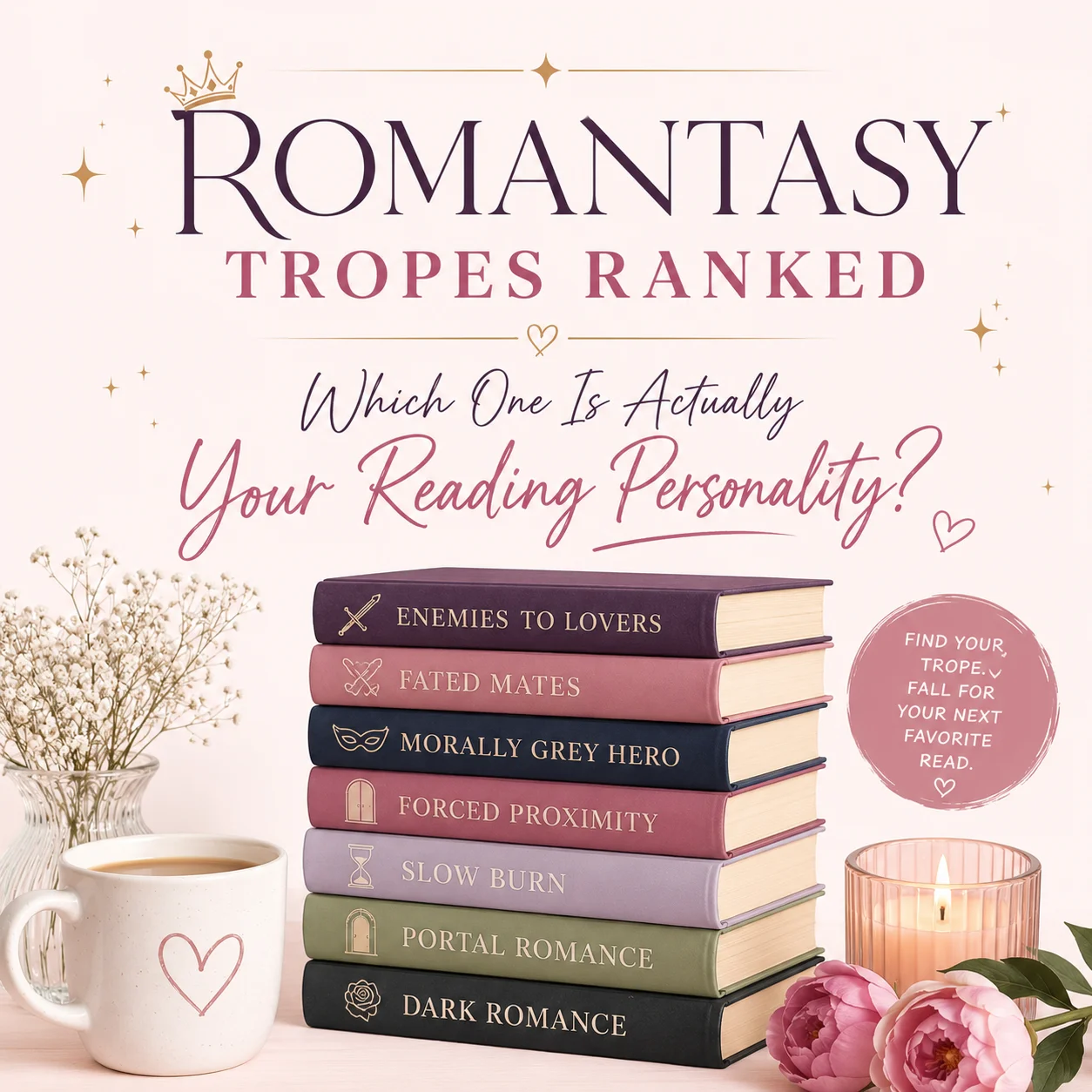
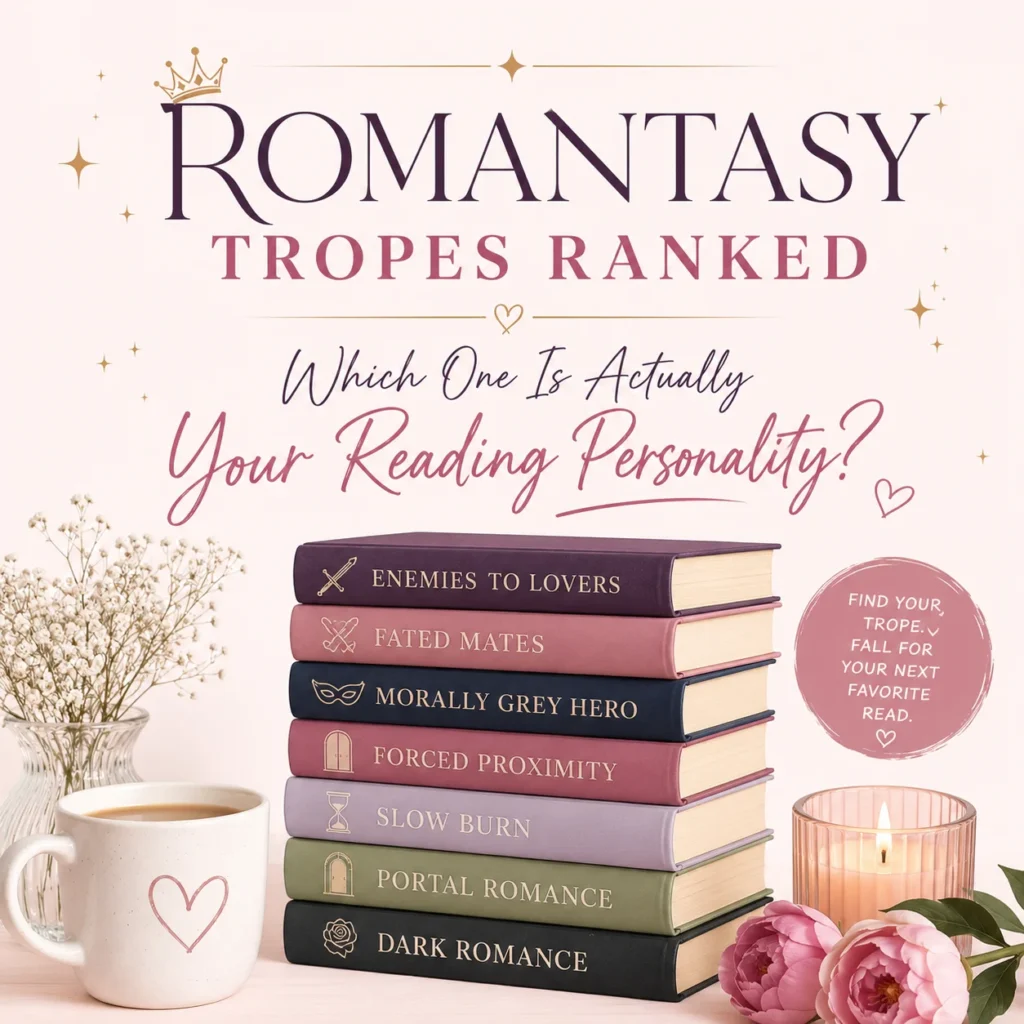
Romantasy Tropes Ranked — Which One Is Actually Your Reading Personality?
There is a moment every fantasy romance reader knows well. You finish a book absolutely wrecked in the best possible way and you immediately text someone about it. You cannot explain exactly why it hit so hard. It was not just the writing. It was not just the world. It was something specific — a dynamic, a setup, a slow unraveling between two characters that felt inevitable from the very first page.
That something has a name. It is a trope. And understanding which tropes actually speak to you is the single most useful thing you can do for your reading life.
At The WellLovedShelf.com we travel across Brevard County every week talking to readers about exactly this. What they loved. What fell flat. What made them stay up until two in the morning even though they had work the next day. After hundreds of those conversations we have learned something important — most readers have a trope that almost never fails them and one or two that consistently disappoint no matter how good the book otherwise is.
This guide is designed to help you figure out which category you fall into. Read through all of them. Be honest with yourself. And then come find us at our next stop in Melbourne, Viera, Cocoa, Palm Bay, or Titusville and we will hand you the exact book that matches your reading personality.
What Is a Trope and Why Does It Matter
A trope is a recurring story pattern that readers seek out and recognize. In fantasy romance tropes are not a sign of lazy writing — they are a promise. When a book is marketed as enemies to lovers you know roughly what emotional journey you are signing up for. When a back cover mentions a mating bond you know the slow burn is going to be exquisite. Tropes allow readers to find the emotional experience they are in the mood for without having to read blind.
The mistake some readers make is thinking tropes are all the same. They are not. A enemies to lovers arc written by Holly Black feels completely different from one written by Jennifer L. Armentrout even though they share the same structural bones. The trope is the container. What the author fills it with is everything.
Understanding your tropes helps you pick the right book at the right time. It also helps people like us at The Well-Loved Shelf put the right recommendation in your hands faster.
The Tropes — Ranked by Reader Personality
Enemies to Lovers — The Tension Addict
You are probably the kind of reader who has said out loud at some point that you do not care about the destination as long as the journey is good. You read for the middle. For the charged silences. For the moment two characters who are actively trying not to fall in love accidentally reveal something soft and unguarded and look away too quickly.
Enemies to lovers works because the conflict between the characters creates an obstacle that makes every tiny moment of warmth feel earned. You cannot have them fall into each other’s arms in chapter two if they genuinely despise each other. Which means by the time they finally get there you have been waiting through dozens of chapters of electric tension and the payoff is enormous.
The best enemies to lovers fantasy romance does not give you characters who are just sarcastic with each other. It gives you characters with real grievances, real history, and real reasons to resist. That is what separates the great ones from the ones that feel hollow. check Well loved shelf website
You are an Enemies to Lovers reader if: The slow burn matters more to you than the destination. You love pointed dialogue. You reread the almost-moments more than the actual moments.
Best picks from our shelf:
The Cruel Prince by Holly Black — Cardan and Jude have one of the sharpest, most complicated dynamics in the genre
A Court of Mist and Fury by Sarah J. Maas — the shift in this book is one of the most discussed in all of romantasy
From Blood and Ash by Jennifer L. Armentrout — the tension between Poppy and Hawke is slow and absolutely relentless
Fated Mates and Mating Bonds — The Believer in Inevitability
You believe in the idea that some people are meant for each other and you want your fiction to reflect that on the most dramatic possible scale. A mating bond is a magical connection — sometimes called a bond, a fated pair, a soul thread, or a true mate — that ties two characters together in a way that cannot be undone.
What makes this trope so powerful is the tension between the bond and free will. The characters do not have to accept the bond. They can fight it. They can deny it. They can spend two hundred pages pretending it does not exist. But it does exist and the reader knows it and that dramatic irony creates a kind of delicious ache that runs through every chapter.
The mating bond trope also delivers some of the most emotionally devastating scenes in the genre. The moment a character realizes they are bonded. The moment they try to reject it. The moment they stop fighting and the whole book shifts. If those moments consistently destroy you in the best way you are a fated mates reader.
You are a Fated Mates reader if: You love the feeling of inevitability. You want the universe to be working for the relationship even when the characters are working against it. The word bond makes your pulse spike.
Best picks from our shelf:
A Court of Thorns and Roses series by Sarah J. Maas — mating bonds are central to the entire series arc
From Blood and Ash series by Jennifer L. Armentrout — the bond here unfolds across multiple books and the payoff is massive
Fourth Wing by Rebecca Yarros — the connection between Violet and Xaden has that same sense of forces pulling them together against their will
Morally Grey Hero — The Reader Who Roots for the Wrong One
Let us be honest with each other. You are not here for the good man. You are here for the man who has done questionable things, who operates in shadow, who would not survive a background check, and who somehow has your complete loyalty by chapter three.
The morally grey hero is one of the defining features of fantasy romance in 2025. He is not a villain exactly but he is not clean either. He has made choices driven by self-preservation or survival or a code of ethics that does not line up neatly with what society would call good. And the romance with him works because the female lead sees something in him that nobody else has bothered to look for.
What separates a genuinely good morally grey hero from a bad one is complexity. He needs real motivations. His grey areas need to come from somewhere specific and understandable even if not excusable. And crucially — he does not get redeemed by the love of a woman. He is who he is. She falls for who he is. That is the whole point.
You are a Morally Grey Hero reader if: You have very firm opinions about Rhysand. You have probably argued on behalf of a fictional man in a group chat. You find straightforward good men slightly boring in fiction.
Best picks from our shelf:
A Court of Mist and Fury by Sarah J. Maas — Rhysand remains the gold standard example of this trope done right
The Cruel Prince by Holly Black — Cardan is cruel in ways that are specific and historically explained
Fourth Wing by Rebecca Yarros — Xaden carries secrets and a personal code that makes him deeply compelling
Forced Proximity — The Reader Who Loves No Escape
One cabin. One mission that requires weeks of travel. One treaty that demands two rivals share a court. One snowstorm that traps enemies together overnight. Forced proximity is exactly what it sounds like — circumstances engineer closeness that neither character would have chosen and the result is intimacy that cannot be avoided.
This trope works because it removes the easy outs. In normal life people can avoid each other. They can create distance. They can choose not to show up. Forced proximity takes that choice away and makes characters deal with each other in sustained, sometimes uncomfortably close quarters. You learn a lot about a person when you cannot walk away from them. That learning is where the romance lives.
Forced proximity pairs especially beautifully with enemies to lovers because the forced closeness becomes the mechanism that breaks down the walls between characters who have chosen to keep their distance. The tension multiplies when they cannot escape each other.
You are a Forced Proximity reader if: You love the before. The almost. The accidental touch that neither character acknowledges. The moment one of them realizes they have started watching the other without meaning to.
Best picks from our shelf:
A Deal with the Elf King by Elise Kova — Luella and Eldas are thrown together by circumstance in a world she does not understand
The Bridge Kingdom by Danielle L. Jensen — political alliance puts two adversaries in constant dangerous proximity
A Court of Thorns and Roses by Sarah J. Maas — Feyre trapped in the faerie world with Tamlin is forced proximity at its most foundational
Slow Burn — The Reader with Infinite Patience and Zero Regrets
You have been called patient by people who do not understand that what you actually are is a connoisseur of anticipation. You know that the best slow burns make you feel more by withholding than most books achieve by delivering. You have read three hundred pages of a book where two characters have not kissed yet and you felt more tension in those pages than other readers feel in an entire explicit scene.
Slow burn is about the accumulation of small moments. A glance held a beat too long. A hand offered that did not need to be offered. A conversation that started as something practical and became something else without either person meaning it to. The slow burn reader tracks all of these micro-moments because they know each one is building toward something and the architecture of that building is the whole point.
The slow burn works best when both characters have genuine reasons to resist the pull between them. External forces, internal fears, circumstances that make closeness feel impossible or dangerous. The resistance has to be credible. If there is no real reason they cannot just admit how they feel the slow burn becomes frustrating rather than aching.
You are a Slow Burn reader if: You have skipped ahead once, felt guilty, and gone back to read in order. You know the difference between a good slow burn and a book that is just stalling. You appreciate the long game.
Best picks from our shelf:
A Deal with the Elf King by Elise Kova — genuinely tender and patient in the most satisfying way
Daughter of the Moon Goddess by Sue Lynn Tan — the romance is quiet and earned across a sweeping epic
The Bridge Kingdom by Danielle L. Jensen — political tension makes every soft moment feel dangerous
Portal Fantasy Romance — The Reader Who Loves Discovery
An ordinary person is transported into a world they did not know existed and has to learn its rules while falling in love with someone who was born knowing them. Portal fantasy romance gives you the joy of discovery built directly into the structure of the narrative. You learn the world at the same pace as the protagonist.
This trope is especially warm and welcoming because the reader and the lead character are in the same position — both strangers to this world, both figuring it out as they go. The love interest becomes a guide and a teacher and sometimes a translator between the protagonist’s old understanding and her new reality. That dynamic creates intimacy that is specific and wonderful.
Portal romance tends to run lighter on the dark end of the spectrum than some other fantasy romance sub-genres which makes it an excellent recommendation for readers who are newer to romantasy or who want something with a warmer emotional temperature.
You are a Portal Romance reader if: You love the fish-out-of-water dynamic. Discovery makes you happy. You want to fall in love with the world alongside the protagonist.
Best picks from our shelf:
A Deal with the Elf King by Elise Kova — the gentlest and most satisfying portal romance on the shelf
A Court of Thorns and Roses by Sarah J. Maas — Feyre’s discovery of the faerie world is portal romance on a grander and darker scale
Dark Fantasy Romance — The Reader Who Does Not Need a Clean World
You do not need the world to be good. You do not need the characters to make choices you would make. You do not need hope to be easy or love to be comfortable. You are here for the complicated version of everything and you want your romantasy to reflect the fact that real feeling lives in dark places just as much as bright ones.
Dark fantasy romance deals with heavy themes. Captivity, violence, moral compromise, grief, power imbalances, and characters doing things that cannot be easily forgiven. The romance does not redeem the darkness — it exists within it. Two people finding each other inside difficult circumstances without the world becoming easier or safer.
This sub-genre requires the most careful content consideration before reading. It is also the most intense and the most specific in what it delivers. Readers who love dark fantasy romance tend to love it with an intensity that is hard to explain to people who have not experienced the right book in this space.
You are a Dark Fantasy Romance reader if: You do not flinch at morally complicated situations. You want your fiction to go to real dark places. You have read books that required a decompression walk afterward and would do it again.
Best picks from our shelf: Ask us directly at any stop. Dark romance is the sub-genre where personal conversation about content and preference matters most. We will find you exactly the right one.
Trope Compatibility — What Works Together
Some tropes pair naturally with others. Here is a quick guide to the most beloved combinations in the genre.
| Primary Trope | Pairs Beautifully With | Why It Works |
| Enemies to Lovers | Forced Proximity | Proximity accelerates the breakdown of walls between enemies |
| Fated Mates | Slow Burn | Fighting the inevitable bond across hundreds of pages is devastating in the best way |
| Morally Grey Hero | Enemies to Lovers | The conflict between them is more credible when he is genuinely complicated |
| Forced Proximity | Slow Burn | No escape plus patient tension is a perfect combination |
| Portal Romance | Forced Proximity | Being a stranger in a strange world with one guide creates natural intimacy |
| Dark Romance | Morally Grey Hero | Dark settings require complex characters who fit within them |
Your Trope, Your Next Read — A Quick Reference Table
| If You Love | Start With | Then Read |
| Enemies to Lovers | The Cruel Prince — Holly Black | A Court of Mist and Fury — Sarah J. Maas |
| Fated Mates | From Blood and Ash — Jennifer L. Armentrout | A Court of Thorns and Roses — Sarah J. Maas |
| Morally Grey Hero | A Court of Mist and Fury — Sarah J. Maas | Fourth Wing — Rebecca Yarros |
| Forced Proximity | A Deal with the Elf King — Elise Kova | The Bridge Kingdom — Danielle L. Jensen |
| Slow Burn | A Deal with the Elf King — Elise Kova | Daughter of the Moon Goddess — Sue Lynn Tan |
| Portal Romance | A Deal with the Elf King — Elise Kova | A Court of Thorns and Roses — Sarah J. Maas |
| Dark Romance | Come ask us at any stop | We will find exactly the right one for you |
How We Use This at The Well-Loved Shelf
When you come find us at any of our stops across Brevard County — Melbourne, Viera, Cocoa, Palm Bay, Titusville — the first question we usually ask is what you loved most about the last book you read. Not the plot. Not the world. What did it feel like? What did it do to you?
That question almost always leads directly to a trope. And once we know your trope we can put the right book in your hands in about thirty seconds.
Every book on our shelf is hand-picked and comes with real information about content, spice level, and trope focus. No surprises. No guessing. Just the right book for you specifically at this moment.
Check our locations page for this week’s stops. Special orders always welcome. Come tell us your trope and we will do the rest.
Frequently Asked Questions
Can a book have more than one trope?
Absolutely. Most great fantasy romance novels combine multiple tropes. Enemies to lovers and forced proximity appear together constantly. Fated mates and slow burn are natural partners. The trope is a starting point for the conversation not a rigid category.
What if I do not know my trope yet?
That is what we are here for. Come tell us what you have read, what you loved, and what you wanted more of. We will figure out your trope together and put the right book in your hands.
Are some tropes only for experienced fantasy romance readers?
Not really. Every trope has entry-level books and deeply complex ones. A Deal with the Elf King is portal romance and slow burn that is genuinely accessible to new readers. Dark romance requires more self-knowledge about what you can handle but that is true at any experience level.
Do you carry books from all these trope categories at your stops?
Yes. Our shelf covers the full range of fantasy romance sub-genres and tropes. If we do not have a specific title at a given stop reach out and we will bring it to the next one.